INTRODUCTION :
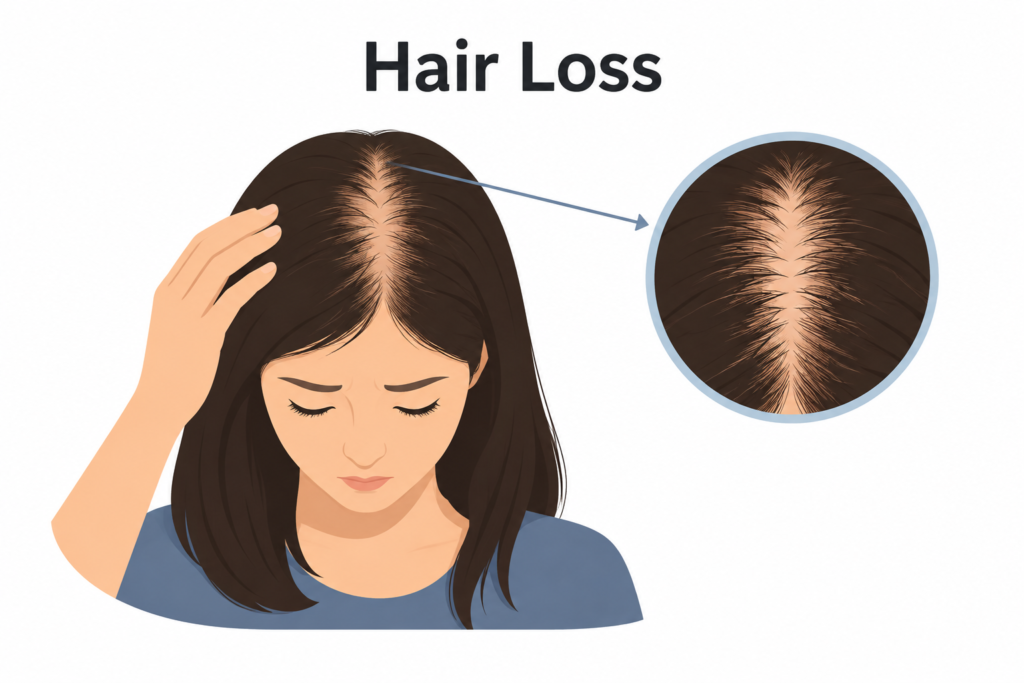
Hair loss, or alopecia, affects millions of people worldwide across all ages and genders. It occurs when the natural hair growth cycle (comprising growth, transition, and shedding phases) is disrupted. While shedding 50 to 100 strands daily is normal, excessive hair loss can cause noticeable thinning or bald patches.
The causes are diverse, ranging from genetic predispositions like androgenetic alopecia (pattern baldness) to temporary triggers such as severe stress, hormonal changes, nutritional deficiencies, and underlying medical conditions. Early identification of the root cause is essential, as many forms of hair loss can be managed or reversed through proper care and treatment.
HAIR GROWTH CYCLE :
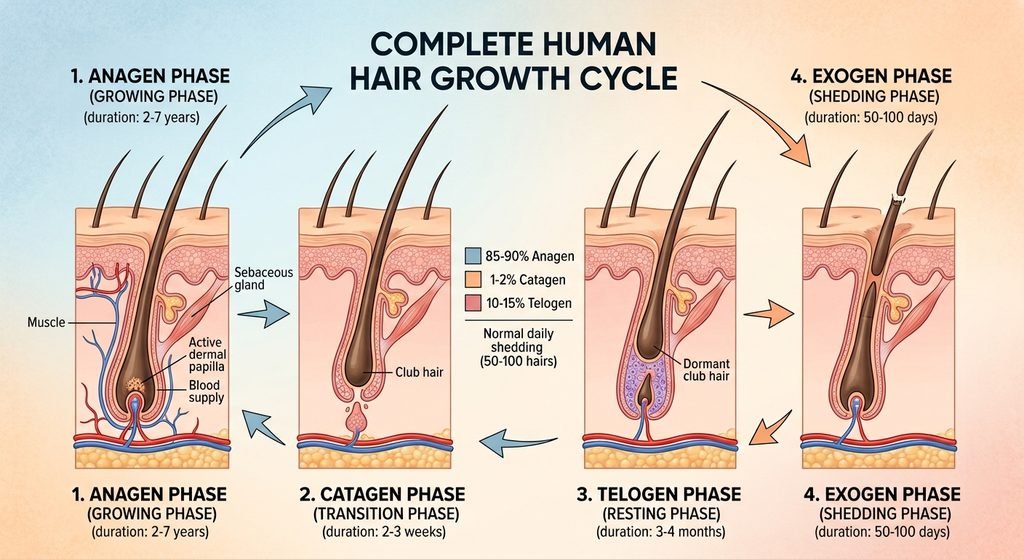
The hair growth cycle is a continuous, four-stage physiological process that governs the development, maintenance, and natural shedding of human hair. At any given moment, each hair follicle operates independently through these distinct phases: anagen, catagen, telogen, and exogen.
The anagen phase serves as the active period of growth, during which hair matrix cells in the follicle bulb divide rapidly to build the hair shaft. Lasting anywhere from two to seven years, this extended phase dictates maximum hair length and encompasses approximately 85% to 90% of all healthy scalp hair. Transitioning out of active growth, the follicle enters the catagen phase, a brief, two-to-three-week regressive stage where hair growth halts and the follicle shrinks, forming a structure known as club hair. Following this transition is the telogen phase, a resting period lasting about three to four months. During telogen, the existing club hair remains dormant while cellular activity at the base prepares to initiate a new cycle. Finally, the exogen phase marks the shedding process, where the old strand detaches from the scalp resulting in the normal daily loss of 50 to 100 hairs to allow a newly forming anagen hair to emerge.
Understanding this natural progression is vital, as disruptions at any stage can trigger premature shedding or thinning. Factors such as severe emotional or physical stress, hormonal imbalances, nutritional deficiencies, aging, and clinical conditions can force a high percentage of anagen hairs into premature telogen, leading to conditions like telogen effluvium. Maintaining a healthy hair growth cycle depends on balanced physiology, adequate blood circulation to the hair bulb, and proper cellular nutrition to support continuous cellular division and regeneration.
HOW CAN RECOGNIZED THE HAIR LOSS :
Recognizing the early signs of excessive hair loss requires careful observation of daily hair shedding, changes in scalp visibility, and structural alterations in individual hair strands. While losing 50 to 100 hairs per day is a normal part of the exogen phase, noticing significantly larger clumps of hair on your pillow, in the shower drain, or on your hairbrush often signals an abnormal shift in the growth cycle. Beyond counting loose strands, spatial changes across the scalp serve as primary visual indicators. In men, this frequently manifests as a receding hairline around the temples or thinning at the crown, whereas women more commonly experience a gradual widening of the center part or diffuse thinning across the top of the scalp.
Another key method of recognition is monitoring the texture and thickness of the hair itself over time. Before a follicle ceases production entirely, it often undergoes miniaturization, producing progressively shorter, finer, and weaker strands known as vellus-like hairs. This process reduces overall volume, making the scalp increasingly visible under bright light or when the hair is wet. Sudden changes in scalp sensation, such as localized itching, burning, tenderness, or excess flaking, can also indicate underlying inflammatory conditions like seborrheic dermatitis, which can exacerbate hair shedding. Additionally, performing a simple self-assessment, such as gently running fingers through a small section of clean, dry hair, can help identify active loss; pulling away more than five or six strands consistently suggests elevated shedding. Early recognition of these visual and tactile cues allows individuals to seek timely evaluation from a dermatologist or trichologist to pinpoint the root cause and implement targeted intervention.
WHAT ARE THE REASONS FOR HAIR LOSS :
Hair loss occurs when the natural balance of the hair growth cycle is disrupted, causing hair to shed prematurely or stop growing altogether. The factors contributing to excessive hair thinning and shedding are diverse, encompassing genetics, physiological stress, hormonal shifts, nutritional status, medical conditions, and external habits.
Genetic Factors
The most widespread cause of progressive hair thinning is androgenetic alopecia, commonly referred to as male- or female-pattern baldness. This hereditary condition is driven by a genetic sensitivity to dihydrotestosterone (DHT), an androgen hormone that causes susceptible hair follicles to undergo miniaturization over time. As follicles shrink, they produce thinner, shorter hair strands until they eventually cease producing hair completely.
Hormonal Changes and Medical Conditions
Fluctuations in hormone levels can significantly impact follicle health. Significant hormonal shifts during pregnancy, childbirth, menopause, or thyroid dysfunctions (such as hypothyroidism or hyperthyroidism) often trigger temporary or long-term hair shedding. Additionally, autoimmune conditions like alopecia areata cause the immune system to mistakenly attack hair follicles, resulting in patchy hair loss. Scalp infections, such as ringworm (tinea capitis), and inflammatory skin conditions like seborrheic dermatitis can also damage follicles and impair growth.
Physiological Stress and Illness
A common cause of sudden, widespread shedding is telogen effluvium, a condition where a high percentage of growing hairs are abruptly forced into the resting phase. This typically occurs two to three months after a major physical or emotional shock, such as high fever, severe illness, major surgery, rapid weight loss, or severe psychological stress. Fortunately, hair density often recovers once the underlying stressor is resolved.
Nutritional Deficiencies and Medications
Hair follicles require a steady supply of nutrients to support rapid cellular division. Deficiencies in essential vitamins and minerals, particularly iron, zinc, vitamin D, protein, and B vitamins, can weaken hair structure and accelerate shedding. Furthermore, several classes of medications can cause hair loss as a side effect, including drugs used for cancer (chemotherapy), hypertension, depression, arthritis, and heart problems.
Styling and Environmental Stressors
External practices can also inflict physical damage on the hair and scalp. High-tension hairstyles like tight ponytails or braids exert continuous traction on the hair root, leading to traction alopecia. Frequent heat styling, harsh chemical treatments (such as bleaching or perming), and poor scalp hygiene further compromise the hair shaft and surrounding skin, contributing to breakage and follicle distress.
HOW CAN MANAGED HAIR LOSS NATURALLY :
Managing hair loss naturally involves adopting holistic lifestyle, dietary, and scalp-care habits that support healthy follicle function and optimize the growth cycle. While natural strategies may not fully reverse genetic conditions, they create an optimal environment for hair retention and growth.
Nutritional Optimization:
Consume a balanced diet rich in micronutrients essential for hair structure, such as iron, zinc, biotin, vitamin D, and omega-3 fatty acids. Adequate protein intake is equally critical, as hair fibers are primarily composed of keratin.
Scalp Stimulation and Oils:
Regular scalp massage enhances blood microcirculation to the dermal papilla, delivering vital oxygen and nutrients to active follicles. Essential oils, such as rosemary or peppermint oil diluted in a carrier oil (like jojoba or coconut oil), have demonstrated potential in stimulating growth and improving hair density.
Stress Management:
High stress levels elevate cortisol, which can prematurely push hair into the telogen (resting) phase. Practicing mindfulness, yoga, regular exercise, and ensuring adequate sleep help stabilize hormone levels.
Gentle Hair Care Practices:
Avoid tight hairstyles that pull on the roots, limit high-heat styling tools, and choose gentle, sulfate-free shampoos to prevent physical breakage and scalp inflammation.
REFERENCES :
- Guo, E.L. and Katta, R. (2017) ‘Diet and hair loss: effects of nutrient deficiency and supplement use’, Dermatology Practical & Conceptual, 7(1), pp. 1–10.
- Koyama, T., Kobayashi, K., Hama, T., Murakami, K. and Ogawa, R. (2016) ‘Standardized scalp massage results in increased hair thickness by inducing stretch forces to hair follicle cells in the subcutaneous tissue’, Eplasty, 16, p. e8.
- Malkud, S. (2015) ‘Telogen effluvium: a review’, Journal of Clinical and Diagnostic Research, 9(9), pp. WE01–WE03.
- Otberg, N., Finner, A.M. and Shapiro, J. (2007) ‘Androgenetic alopecia: pathophysiology and treatment’, Dermatologic Clinics, 25(2), pp. 155–163.
- Panahi, Y., Taghizadeh, M., Marzony, E.T. and Sahebkar, A. (2015) ‘Rosemary oil vs minoxidil 2% for the treatment of androgenetic alopecia: a randomized comparative trial’, Skinmed, 13(1), pp. 15–21.
- Paus, R. and Cotsarelis, G. (1999) ‘The biology of hair follicles’, The New England Journal of Medicine, 341(7), pp. 491–497.
- Sinclair, R.D. (1998) ‘Hair shedding and hair loss’, International Journal of Dermatology, 37(10), pp. 721–739.
- Stenn, K.S. and Paus, R. (2001) ‘Controls of hair follicle cycling’, Physiological Reviews, 81(1), pp. 449–494.
- American Academy of Dermatology (n.d.) Hair loss: diagnosis and treatment. Available at: https://www.aad.org (Accessed: 21 September 2026).
- British Association of Dermatologists (n.d.) Patient information leaflets: alopecia. Available at: https://www.bad.org.uk (Accessed: 21 September 2026).
0 Comments